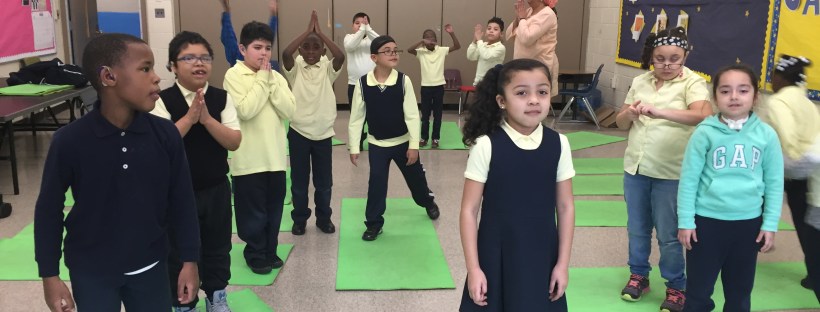
Sannyasi Samatamurti (Anne Monsees), teaches yoga in schools on a large scale in Newark Public Schools. Newark Yoga Movement is a nonprofit organization founded in 2009 by Debby Kaminsky. Newark Yoga Movement (NYM) teaches pre-k through 12th grade students, children having special needs, educators, and parents/caregivers. Since its inception NYM has taught over 30,000 students, 3,600 educators and thousands in the community through nine free weekly classes. Currently, the organization is in 25 schools offering 150 weekly classes to children.
The aim of teaching yoga in schools is to give children tools to help them self-regulate, reduce stress and anxiety, increase focus, peacefulness and confidence, as well as unleash creativity. The yoga programs offered in schools are tailored to meet classroom needs. As a result of these programs, there is data showing disciplinary actions being reduced to almost zero and suspensions to zero.
Samatamurti has been instructing yoga in schools since 2015 and is a Special Education Teacher as well as a Satyananda Yoga instructor. During the 2017-18 school year she taught at six different schools, in over 30 different classrooms in Newark, every week. Offering yoga in schools gives children in the whole community the opportunity to practice yoga and exposes them to techniques that will enhance their learning and education.
Highlights from Bruce Street School
Bruce Street School is comprised of students with varying degrees of hearing loss, from hard of hearing to profoundly deaf. One student is both deaf and blind. There are 76 students participating in yoga classes at Bruce Street School. The children have varied communication skills, from all American sign language (ASL) to good verbal communication.
There are three different classes each week at the school with 16-20 students in each class. Students range in age from 7-14 years old and are in 2nd-8th grade. Yoga classes are 50 minutes. This is a little more time than is recommend. Usually yoga classes in schools are only 15-20 minutes. However, this school dedicated one full period to yoga and due to the children’s needs the extended time is appropriate. The length of the yoga class is important to consider when teaching yoga in the classroom. The aim of practicing yoga during the school day is to increase the students’ ability to learn and focus. It should not disrupt the learning environment or interfere with the classroom teacher’s teaching time. Also, the age group and attention span of the students should be considered. In gerenal,15-20 minutes is enough time for students practice a balanced set of asanas and experience relaxation.
The setting in schools and classrooms is always different and it is best not to waste time rearranging the room. It is fortunate that at Bruce Street students practice yoga in an empty classroom and have the use of yoga mats. To create openness and unity, the mats are arranged in a circle. The instructor places a mat at the center of the circle so students can take turns demonstrating and leading different yoga positions. Being in the center is a great way to develop self-confidence and leadership skills. Being chosen to be in the center can also be used as a motivational tool to increase class participation. When the student is in the center of the circle they have an opportunity to demonstrate their understanding of the practice and show the class how it is to be done. With more practice and a growing interest, they may eventually be able to instruct the practices to the other students in the class.
It is important to connect with every student during each class. Taking attendance allows the teacher to learn the children’s names and this allows each student to feel special. Eye contact is important with children who are deaf. The yoga instructor will greet every student by making eye contact and waving or saying, “Namaste”, “Hello”, or “Good morning” in ASL.
The use of visual aids enhances learning for all students, especially for students with hearing loss. The visual aids should be simple and can include: pictures of asanas (yoga poses), breathing practices, and written definitions of yoga terms discussed in class. For this class, the instructor learned key words in sign language and gradually increased her vocabulary over the school year to integrate sign language more throughout the classes.
There is a certified interpreter in each class who plays a key role facilitating communication and encouraging students to listen, focus and participate. The interpreter, has a genuine interest in the yoga classes and participates too. This has a had a positive influence on the students and has greatly improved the quality of the class. This is the interpreter for all the classes and she gets to participate in yoga three times a week!.
The other teachers and assistants that are in the classroom can either act as a great help and support, or as a disturbance and a hinderance. When you are instructing yoga in the classroom, you become the main teacher of the class, and it is your responsibility to set the tone for other adults in the room. If they do not want to participate themselves, that is their choice, but they should remain engaged with the students and assist the students as needed.
Get the Students’ Attention
An important tool that can be used during yoga classes is a Tibetan Singing Bowl. Chimes or another instrument can also be used. The sound of the singing bowl creates a positive vibration within the yoga class and is used to gain students’ attention without the teacher raising their voice. When the bowl rings it is time to get started. The sound of the bowl means to stop talking, be still and sit up straight. Using the singing bowl throughout the class may be needed to refocus students, or to transition between activities. Students always want to ring the bowl, and usually show respect for it.
Emphasize that the singing bowl makes a sound that creates a vibration that can be heard and felt. Demonstrate how to hold and play the singing bowl and then give students a chance to play it and feel the vibration in their hand. We all create vibrations within the body with sound, but when students are deaf, many times they do not create any sounds. When the singing bowl is held still in the palm of the hand and the vibration is felt, the students who are deaf are able to understand the connection between sound and vibration. The positive vibrations created during the yoga practices are very much experienced in each class.
Structure of Yoga Class
Teaching yoga to children requires patience, structure and it should be fun and engaging. Repetition is necessary and progression should be gradual when introducing new asanas and yoga philosophies. At Bruce Street the class developed a balanced routine that consisted of: short meditation, sankalpa – positive affirmation, warm ups, standing asanas, breathing practices and Om chanting.
Beginning Each Class with Positivity
The opening meditation consists of body stillness, breath awareness and Om chanting. “Please sit with the back straight and tall. Feel the breath. Breathe longer and deeper. Chant Om 3 times all together.” Stating in stillness creates a class routine and is a peaceful way to transition into yoga. Yogic philosophies that are used as themes to focus on throughout class include: Om and vibration, sankalpa (intention or aspiration), awareness, and developing positivity in life. Common class objectives include: how to relax, be calm, focus, have self-control and feel positive and proud.
A positive tone is set for class when sankalpas, or positive affirmations, are shared and repeated. A good activity to try when first learning about sankalpa is to have students raise their hands if they want to share their intention/goal. One student is called on the share, and then the whole class repeats the goal three times. At Bruce Street they say and sign the sankalpa. If most of the students want to share, go around in a circle one by one without repeating as a whole class to save time. It is important to facilitate the group to move along and stay focused. If students do not want to share they have the opportunity to pass. Examples of positive sankalpas for children and teens include: I make good decisions. I will do my best. I am smart. I am valuable. I can do it! I am beautiful. I will go to college. Repeating positive affirmations and choosing a sankalpa are powerful yoga tools for life. The power of yoga is well documented and yoga is accessible to all, it does not make a difference that these students are deaf.
Classes also starts with singing (and signing) a very popular yoga song written by Yogi Bhajan from the tradition of Kundalini Yoga. There are hand movements that go along with the Sanskrit words, and the volume of the voice changes each round the song is repeated, from normal to whisper to silent, back to whisper, and normal. The words of the song and movements that correspond are: “I am happy. I am good. I am happy. I am good.” Movements include pointer fingers on both hands moving around in the air. “Sat Nam. Sat Nam. Sat Nam Ji.” Movements include bring the palms together first at the heart with the first Sat Nam, then at the throat with the second and then third at the forehead. “Ji,” open the hands out to the side. “Wahai Guru Wahai Guru Wahai Guru Ji.” Movements include putting the hands in fists and rolling them around each other in front of the chest. When saying, “Ji” open the hands out to the sides. There is 100% participation with most classes and students will request to sing it if it gets left out. “I am happy. I am good,” is a perfect example of a simple, short and concise sankalpa. It often gets stuck in one’s head and teachers will hear the students repeating it throughout the day.
Also try, “Peace begins with me”. Students can say the sentence tapping each finger on the thumb, switching fingers as each word is said. For example, “Peace” place pointer finger on thumb. “Begins” the middle finger connects to the thumb. “With” connect the ring finger to the thumb. “Me” connect the little finger to the thumb. Repeat several times, changing the speed and volume.
Asanas
Warm ups include selected asanas from Pawanmuktasana series 1 & 3. With children it is best to keep it simple and use the English or familiar names for the asanas. Also, keep the class moving, do not move too slowing or give long explanations. Joint exercises and energy releasers may consist of: Greeva Sanchalana (neck movements), Skandha Chakra (shoulder rotation), Janu Naman (knee bends), Poornam Titali Asana (full butterfly), Nauka Sanchalanasana (rowing the boat), and Chakki Chalanasana (churning the mill), Jhulana Lurhakanasana (rocking and rolling), etc.
Stand for another set of asanas that may include: Tadasana (palm tree pose), Tiryaka Tadasana (swaying palm tree pose) and Kati Chakrasana (waist rotating pose), Ha Breathing or Kashtha Takshanasana (chopping wood), Ashwa Sanchalasana (equestrian pose), Akarna Dhanurasana (bow and arrow pose) and Eka Pada Pranamasana (balancing tree pose). Keep the students engaged by counting the rounds in different languages or prompting students to use their imagination in different asanas. For example, in balancing tree pose, imagine that the feet are the roots, the body is the trunk of the tree and the arms the branches. Then once all the students have one leg up, start counting up to ten in Spanish, Hindi or English, or any other language. The instructor in this class also counts in sign language by holding her hand her above her head and showing the numbers on her fingers. You can also count with Om. After each number say Om to slow the count down and to add vibration. One Om, two Om, three Om, etc. Counting with Om brings a relaxed stillness to the practice and usually most students join in and harmonize the sound of Om.
Recently, one student who is profoundly deaf, started counting aloud one to ten while we were balancing in Eka Pada Pranamasana. The teachers were amazed and the interpreter who knows her well was also impressed and commented that it was unusual. With the right opportunity, and encouragement students gain skill and confidence and express more of their innate abilities and potential.
Some students at Bruce Street also have physical disabilities in their arms and/or legs, and others have more serious medical conditions. It is important to move slowly and get to know the students personally before progressing or trying intermediate asanas. It is important to include as many of the students as possible into the class, but it is also important to keep classes interesting for students who can participate in the asanas more easily.
At Bruce Street School each class has slowly developed the practice of Surya Namaskar. First teach the positions separately and then start to add them into the sequence. 1: Pranamasana (palms touch at the chest), position 2: Hasta Utthanasana (raised arms pose), position 3: Padahastanasana (hands to feet). Then go back to Hast Uttanansana and then Pranamasana. These three asanas were done for several weeks before moving on. Repetition and calling out each number helps students remember the sequence.
Position 4: Ashwa Sanchalasana (equestrian pose) on the right and left sides was also first practiced for several weeks as a static position and was then added to the sequence. The same was done with position 5: Parvatasana (mountain pose). It is important to show different ways to return to Ashwa Sanchalasana from Parvatasana. Do modified ways first. For example, drop onto the knees, pick up one or two hands and step the foot forward. All students should feel successful and should not be made to stand out if they are unable to do an asana. Position 6: Ashtanga Namaskar (salute with 8 parts), and position 7: Bhujangasana (cobra pose) were practiced independently and then added last to the complete the full practice.
During the fourth month of classes the Bruce Street students practiced the entire Surya Namaskar (Salute to the Sun) in the 7-8th grade class, and the younger classes were able to do the full practice by the sixth month. Students were then also confident to guide the practice themselves. One student practiced in the center and called out the numbers while the rest of the class followed their lead. This also gave the instructor the opportunity to move around more freely and assist students as needed.
Pranayama
After the standing asanas, the students sit or lie for breath awareness and pranayama. For Viloma (staircase breathing) visuals of a staircase with arrows moving up and down are very useful. The staircase is used to illustrate the movement of breath slowing moving up and down the stairs and having a slight pause on each step. The straight line up or down illustrates the smooth inhale/exhale moving up and down the escalator without a pause.
Brahmari (bumblebee breathing) is regularly practiced at Bruce Street and helps create a calm mind. Some students wear hearing aids and it is okay if students do not want to cover their ears during Brahmari. This practice increases mental focus and inner silence. The gentle humming creates an external vibration that can also be felt inside the body. This is a beneficial practice to teach to students who are deaf or hard of hearing because it encourages students to create sound. Go around in the circle to listen to the sounds the students each make. If students are not making any sound, put their hand on your throat and have them feel the vibration, if it is appropriate. The instructor may also ask to put their fingers on the sides of the students’ throat. Non-verbal students who were not able to make sounds were able to produce sounds by the end of the school year!
Simhagarjanasana (Roaring Lion Pose) is another practice to experience the feeling of vibration within the body. Roaring Lion Pose builds confidence, bravery and helps improve shuddering.
The class concludes with a few minutes in shavasana, (which students now request to do in every class), sankalpa (mental repetition three times), and quietly sitting up for Om chanting. In the end, we bring our hands together and say, “Namaste.” The students repeat and sign after me, “I see the Light in you. You see the Light in me. We all see the Light in each other. Namaste.”
Yoga Toolbox
Yoga Toolbox is a game that puts yoga philosophies into practice. Write yoga topics like: Om, give, love, focus, sankalpa, happy and positive, serve, etc. on different cards or pieces of paper and put them in a bowl. Students take turns picking a card and leading the group in an asana or practice that illustrates or expresses the meaning of the card. For example: if a student picks “Om”, they can lead the class to chant Om three times all together. Or “focus”, the student comes to the center of the circle and instructs how to practice Eka Pada Pranamasana (balancing tree pose). “Give”, turn the person to your right and left and give them each a compliment, etc. This game develops creativity, leadership skills and demonstrates ways in which yoga can be incorporated into daily life.
Results In the Classroom
Teaching assistants have told the principal how well the yoga classes are going at Bruce Street and have expressed that they see a positive difference in the students, including their attitudes and focus. During the morning announcements the principal reads centering scripts written by Newark Yoga Movement called “Instant Calm”. The scripts are a positive way to begin the school day with yogic awareness. The positive morning announcements also aims to develop school unity between the staff and students and continuity of yoga practices throughout the day. Script themes include: focus on the breath, gentle stretches and topics like humility, feeling valuable and developing responsibility and respect.
When the students who are deaf follow the breathing practices over the loud speaker, the teachers raise their hands upwards to indicate the inhalation and move the hands slowing downwards to indicate the exhalation. This is a way to visualize the movement of the breath (an especially good visual for the students who are profoundly deaf). This technique was first used during yoga class and the teachers and students have been able to adapt it into their daily morning routine. Being aware and following the breath allows us to become calm and peaceful, and in school it increases the ability to learn and stay focused. Being aware of the breath is a simple yoga technique that easily be incorporated into daily life.
Repeating positive intentions as well as using their imaginations have contributed to language development in some students at Bruce Street. The interpreter stated that, “the students have had lots of new exposure and extremely authentic experiences during the yoga classes. Students have been exposed to new language that has increased their vocabulary and fluency of words.”
Yoga gives all students tools that will help them be ready to listen, ready to learn and ready to reach their goals. There has been so much growth and confidence developed in these students as they have learned an asana, a breathing technique or something positive from the yoga classes that they will use and remember for a long time to come. Teaching yoga in schools during the school day is a powerful and innovative way to further education and inspire the children in the inner-city to believe in themselves and stand proudly on their own two feet. This experience has proved that yoga has the power to bring out individual potential, is accessible for all learners and should be included as a valuable aspect of school curriculum throughout the country.
Student Testimonials
“I like when we do the tree pose. The tree pose makes me change and makes me do different things, and better things too. The tree pose is my best!” Za-Quil, 14.
“I like yoga because it is relaxing and it is peaceful, and because you get to become more flexible.” Demetrius, 11.
“I feel peaceful while doing yoga.” Leah, 13.
“Yoga is good for you. All the moves are good.” Angel, 12.
“I am smart. I will pass the PARCC test.” Isaac, 14.
“When you do a lot of yoga you get strong.” Camillo, 7.
Anne Monsees (Sannyasi Samatamurti) is a Satyananda Yoga Instructor and Special Education Teacher from New Jersey, USA. She received her bachelor’s in Elementary Education from University of Vermont and Special Education Endorsement from Bloomfield College. She resided at Bihar School of Yoga, Ganga Darshan from 2006-2009, and at Rikhiapeeth from 2012-2015. In 2010 Samatamurti competed the Satyananda Teacher Training & Diploma Course in Australia. She started teaching for Newark Yoga Movement in 2015, and specializes in teaching yoga in schools to children with special and behavioral needs. The aim of yoga is to develop awareness, and express one’s full potential in life with balance and positivity.
Works-Cited
Newark Yoga Movement. (2009).
Retrieved from http://www.newarkyogamovement.org
Biharyoga.net
 Yoga School NJ