14th Avenue School
Sannyasi Samatamurti teaches at 14th Avenue School, a school for children with special needs through Newark Yoga Movement. There are 50 students in the school, 5-13 years old and have a variety of special needs including Down Syndrome, Autism, low IQ, and developmental disabilities. The teacher goes into seven different classrooms at this school once a week. Each class is 15 minutes. Classes have 2-11 students and yoga is either practiced in a circle on the rug, or the students stay at their seats.
It can be very difficult for students with special needs to follow directions, stay focused or even to independently move their own bodies. The teacher uses different yogic techniques and practices that aim to help students feel calm and peaceful, create healthy and positive samskaras (impressions) and facilitate communication. To carry out these aims it is important to connect with the students individually. Smile and say hello to each student, use the students’ name and make eye contact. Be consistent and repetitive, and stay balanced and calm in every situation. If physical contact is appropriate, touch their hands or put light pressure on their shoulders to show them that you care and that you are there to meet their needs.
How to practice yoga in different schools depends on how the class is arranged, the number of students and the students’ abilities. It is important to do what is practical, does not waste time, is age appropriate and meets the needs of the students. In most classrooms there is not space for each student to use a yoga mat. At 14th Avenue School, both sitting and standing asanas are practiced either at their desks, or their chairs are moved to create a small circle. In one class where the students have low abilities and some aggressive behaviors, the teacher suggested to remain sitting for the entire class. She noticed that the students got distracted and lost focus when they stood up for standing asanas. For several weeks the students only practiced yoga from a seated position and it improved the quality of the yoga class. The yoga instructor should realize the importance of progressing slowly, listening to suggestions from the classroom teachers and adapting to meet the students where their needs are. This way all the students will feel confident and successful in yoga.
In one particular class the yoga instructor also needed to stop instructing “Ha Breath” and “Chopping Wood.” The students would continue to perform the exhale “Ha!” sound after yoga class was finished and continue the loud sound throughout the school day. This practice became disruptive for the classroom teacher. Yoga practices should complement the learning environment and also be a support for the classroom teacher, not a hindrance. As a consequence, these students needed to earn or work to practice “Ha Breath” as a reward for good behavior!
No matter what the age, or ability, Samatamurti always starts and ends the yoga class with settling the body, breath awareness and Om chanting. For example, “Sit with the back straight and tall. Feel the breath. Breathe longer and deeper. Chant Om 3 times all together.” This creates a repetitive expectation that many students with special needs require. Settling the body and mind is also a peaceful transition into the yoga class and gives a focused and calm feeling to return to school work.
One of the main aims for teaching yoga to students with special needs is to give them tools to become calm and to self-regulate. Om chanting is the perfect practice for becoming calm. Tell students that Om is a vibration. It is a positive vibration that you can feel within your own body. Scientifically, Om slows the brain waves and helps make the thoughts quiet and calm. For students with severe disabilities increase the number of times Om is chanted. You can chant Om ten or more times. Ideally, the vibration will have a peaceful and calming effect on the students and staff in the classroom. Usually, by the fifth Om sound students start to tune in and settle down. For students who are non-verbal, take their hand and put it on your throat so that they can feel the vibration of the sound. Encourage them to open their mouths wide and let out any sound.
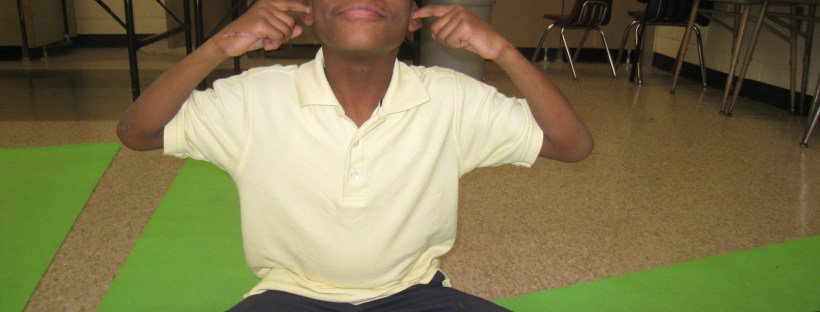
Brahmari is another yoga practice that has a distinct and calming vibration. Demonstrate the smooth “Mmmmmm” sound on the exhalation and show students how to cover their ears to block out external sounds. Tell them to feel and focus on the internal vibration. Yoga practices that create vibrations aim for students with special needs to create any sounds in hopes that it will lead to the development of producing other sounds or methods of communication.
In one particular class at 14th Avunue School there were three students, two boys and one girl, each 6 years old. All students were nonverbal and had mild aggressive behaviors. This was their fourth yoga class together. One student, a boy, had been sleeping during the previous class. He was awake now, sitting across from the teacher, and they were singing the song they sing in every class: “I am happy, I am good.” A song created by Yogi Bhajan from the Kundalini Yoga tradition. We sing and dance in our seats, with our pointer fingers up and say over and over, “I am happy, I am good.” The volume progresses from normal singing voice, into whisper, into silence and then back to whisper, then to normal. When the class went silent, he said softly, “Happy” and then a little louder, “Happy” and a third time loudly, “Happy!” It was his first word! His first word, loud and clear, “Happy.” Since then he has said happy during two more yoga classes!
 Yoga School NJ